
Most lead scoring models rely on static rules and limited inputs. They struggle to predict readiness early and often misclassify buyer interest because the scoring criteria tend not to evolve as more is learned about what drives a prospect to become a buyer. AI-based tools allow a reasonable level of scoring to happen inside the interaction, not after it. If properly executed, this allows downstream “human” sales interactions to be prioritized, lessening wasted time and lead backlog, which itself lessens buying process effectiveness because more “ready to buy” leads are lost by mixing them in with less qualified leads.
Types of External Enrichment
Outside-of-tool enrichment can include:
- Intent data platforms that indicate active research behavior
- CRM historical records showing past engagement or purchasing
- Firmographic enrichment such as size, ownership, or growth signals
- Role and contact validation from third-party sources
- Regional or segment-level clustering to identify broader trends
While these data points add context, not replacement, to AI tool insights, they can be used to help prioritize and provide initial ratings on lead value. They can (and should) of course be integrated into any key account or account-based marketing programs as new buying elements from existing accounts can signal both increased opportunities, but also competitive threats.
Behavioral AI lead scoring
AI tracks how users interact via many tool interaction aspects such as:
- Depth of engagement (i.e. use of many tool sections)
- Time spent in key sections
- Frequency of return visits
- Willingness to refine inputs
These behaviors can signal seriousness more accurately than mere downloads, particularly if a dataset of behaviors are learned from many similar interactions among different users. Tool interaction types such as pain point characterization, authority and role inference, urgency indicators are further areas where a predictive sales model can be created, refined and measured against final results.
Pain-point density/exploration
One of the key ways buying propensity is traditionally determined in many multi-phase sales processes is through determining pain point types and levels. Determining and categorizing these needs are generally how buying potential is assessed and typically requires understanding of potential buyer products/services, roles within their organization, external trends and even buyer emotional signals. By capturing this institutional experience, AI can be “taught” to recognize these buyer indicators by analyzing how often users mention or respond to areas such as:
- Risks to their organization, functions, marketability, pricing, etc.
- Blocks/impediments to achieving their required goals
- Constraints in terms of resources, timeframes, technofixes/function
- Consequences of not achieving their goals from various perspectives (organizationally, departmentally, personally, etc.)
Generally, higher “density” of aggregate pain points correlates with higher urgency and need, but mapping this to a particular aspect of the buying process is often a delicate and intuitive process. Objectivity (and in turn reliability of predictions) can be increased by observing how this process plays out over a wider range of buying situations, a perfect role for AI-based tools because of their ability to provide structure to often unstructured (and unrecorded) buying interactions.
AI Lead Scoring Table
| Scoring Parameter | AI Lead-Scoring Approach | Description | Ease | Accuracy | Effectiveness |
|---|---|---|---|---|---|
| 1 | Behavioral scoring inside the tool | Tracking depth of interaction, clicks, sections visited, time on page | 5 | 3 | 4 |
| 2 | Prompt-based intent extraction | AI evaluates user-written text to determine urgency, authority, budget context | 4 | 5 | 5 |
| 3 | Checklist completion patterns | Scoring based on % completion, gap admissions, and detail depth | 4 | 4 | 5 |
| 4 | Language-based readiness scoring | Natural Language Processing (NLP) analyzes user phrasing for readiness signals (“We must…”, “Deadline is”) | 4 | 4 | 5 |
| 5 | Similarity analysis to past converters | AI compares user behaviors and statements to historic users who converted | 3 | 5 | 5 |
| 6 | Pain-point density scoring | Identifying how often users mention problems, blockers, risks | 5 | 4 | 4 |
| 7 | AI-derived urgency index | AI detects urgency from explicit queries such as perceived time pressure or actual compliance deadlines | 4 | 4 | 5 |
| 8 | Tool difficulty-path analysis | Scoring based on which tool features users explore (basic vs. advanced) | 4 | 3 | 4 |
| 9 | Multi-step engagement scoring | AI watches if users come back repeatedly to refine their inputs | 3 | 4 | 5 |
| 10 | Answer consistency analysis | AI identifies contradictions or high coherence, indicating level of project ownership/use | 3 | 4 | 4 |
| 11 | Role validation | AI analyzes descriptions and perspectives to infer seniority, influence, and decision authority | 4 | 4 | 5 |
| 12 | Budget-inference modeling | AI infers likely budget size from industry, project type, organization size | 3 | 5 | 4 |
| 13 | Scope-complexity scoring | Larger or multi-location implementations score higher via project complexity signals | 4 | 4 | 5 |
| 14 | Predictive scoring based on tool pathways | AI learns which tool actions correlate with higher conversions | 3 | 5 | 5 |
| 15 | User friction analysis | AI estimates likelihood of buying based on confusion vs. confidence signals | 4 | 3 | 3 |
| 16 | Engagement sentiment analysis | AI evaluates optimism, anxiety, frustration, or determination for project momentum | 5 | 4 | 4 |
| 17 | Resource-download scoring | Assigns points for downloading templates, samples, guides | 5 | 3 | 3 |
| 18 | Decision-tree response scoring | Responses to branching questions map to qualification tiers | 5 | 3 | 4 |
| 19 | Project maturity classification | AI tags stages (planning, budgeting, implementation, audit prep) | 4 | 4 | 5 |
| 20 | AI-generated “likelihood-to-buy” heat map | AI assigns likelihood scores based on weighted patterns | 2 | 5 | 5 |
| 21 | Engagement trajectory prediction | AI predicts future engagement from early interactions | 2 | 5 | 5 |
| 22 | Micro-conversion scoring | Email entry, tool saving, exporting reports — scored as conversion signals | 5 | 3 | 4 |
| 23 | Industry-regulation relevance modeling | AI identifies if user is subject to mandatory compliance (strong lead indicator) | 4 | 5 | 5 |
| 24 | Qualified-question scoring | High-quality direct buyer questions trigger high scores (timeline, scope, next steps such as meeting/demo requests) | 4 | 5 | 5 |
| 25 | User-generated requirement extraction | AI identifies internal/organizational mandates such as planning deadlines, assigned tasks, etc. | 4 | 4 | 5 |
| 26 | Comparative analysis of competitors mentioned | User references competitor tools or vendors as risks can equal higher buying intent | 3 | 4 | 4 |
| 27 | Standard/customer requirements scoring | Mentioning specific customer specifications, standard elements or auditing requirements indicates advanced readiness | 4 | 5 | 5 |
| 28 | AI checks for “project champion” behavior | Users who articulate personnel-based justification or team roles score higher | 3 | 4 | 4 |
| 29 | Cross-tool usage monitoring | Users interacting with multiple tools get higher engagement scores | 5 | 4 | 5 |
| 30 | AI-weighted “conversion proxy” events | Creating action plans, exporting tool data, assigning tasks or forwarding information via tool = high qualification behaviors | 5 | 4 |
The above scrolling table provides various potential scoring parameters for determining and predicting sales lead buying viability. The parameters are rated based upon Leadsahead/Callisto Marketing Services’ assessment of potential Ease of Implementation (1= Hardest, 5= Easiest), Accuracy (1 = Low, 5 = High) and Effectiveness ( 1 = Limited, 5 = Strong). Choice of building an actual scoring model depends upon the amount and accuracy/effectiveness of previous sales data and the organization’s goals and resource limitations.
Role and authority inference
By analyzing language and descriptions, AI can infer the traditional authority level (the A in BANT profiling) directly or indirectly. (Even if a person’s title is stated for example when signing up for the tool, confirmation of their role and buying influence/authority can be important as lower level titles can be key in evaluating/exploring initial product/service potentials which are then recommended to higher level buying approvers.) Key factors can be analyzed such as:
- Seniority
- Responsibility scope
- Decision influence
- Technical knowledge/expertise
- Team/group buying leadership/participation
- Evaluation criteria maturity (how well and accurate they know/researched features/benefits)

Tool interaction “micro-conversion” signals
Irrespective of more specific buying interest indicators, tool engagement/interaction actions can be reasonable initial measures of buyer need/interest. The advantage of tracking these “mechanistic” allow sales teams with capacity to discern among which leads may justify more initial qualification, for example how often the prospect:
- Saved sessions
- Exported outputs in reports
- Entered more complete contact information
- Created action/follow-up plans
- Logged in and how much time spent with tool
- Used the same or different device for login
- Requested tool support or accessed tool help sections
Budget inference
Clearly budget is a critical lead qualification step, but can be very elusive until later in the lead qualification journey. However, AI can help estimate likely budget ranges based on:
- Industry
- Organization size
- Project scope
- Competitive information
- Previous similar prospects that resulted in sales
- Prospect tool engagement scope, levels and requests for price estimates/comparisons
The key for budget estimation is going to be timing of direct requests but also indirect assessments. For example, if the AI asks the prospect’s interest in detailed cost estimates very soon in the process without any direct requests/prompts from the prospects, this may lower trust and credibility. However, if the prospect initiates the cost estimating process early on, this can both increase trust/value and provide more accurate budget analyses. (While many buying processes are geared toward only providing product/service costs after an initial sales call/contact, a key differentiator and value addition of the tool could be to provide general cost guidelines.)
External lead scoring/enrichment sources
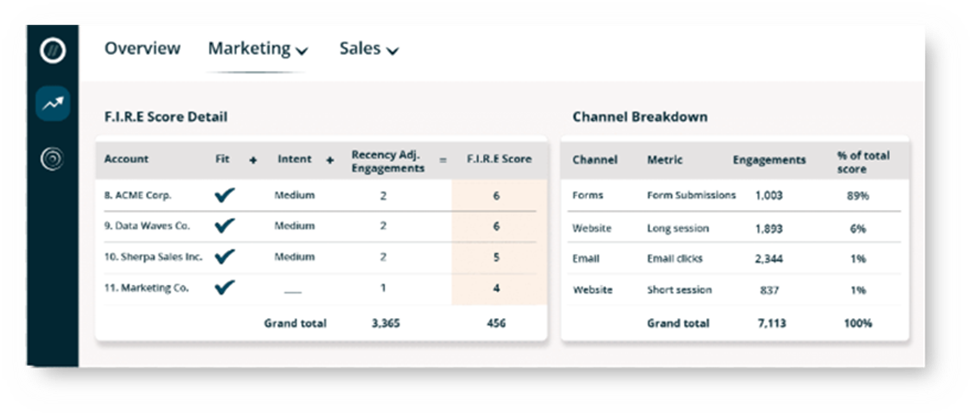
External lead enrichment scoring additions
“Outside-of-tool” lead scoring and enrichment adds essential context to the insights generated within an AI qualification tool. While the tool itself captures deep, first-party signals—such as engagement depth, problem focus, and urgency—external enrichment broadens the view by situating that interaction within a larger market and account-level picture.
This enrichment layer can incorporate third-party buying intent data (i.e. Bombora, 6 sense, ZoomInfo, Clay, etc.) to determine whether the prospect’s organization is actively researching relevant topics, solutions, or competitors across the web. It can also append site-level activity, such as review-platform research behavior (i.e. G2 Buyer Intent), to indicate comparative evaluation beyond a single interaction. In addition, enrichment services can verify and enhance basic firmographic and contact data, including company size, industry, ownership, geographic footprint, and estimated revenue. When aggregated across users, these signals can also be clustered by region or segment to identify broader patterns—helping sponsors distinguish isolated curiosity from coordinated buying initiatives.
Tool connection to external customer relationship management and analytics
Connecting to a sponsor’s CRM, website analytics and email open/clickthrough data further extends this context by revealing historical engagement, prior opportunities, or existing relationships at both the account and contact level. This is the ultimate value addition in creating, maintaining and improving an AI tool-based qualification system. This “two-way” interaction can benefit both the tool’s usefulness and accuracy as well as the Sponsor’s system-wide predictive end-to-end sales closure analytics. Existing CRM records may reveal:
- Prior conversations
- Lost or stalled opportunities
- Past purchasing behavior
- Account-level engagement trends
While this connection can pose some security risks (link to security section), there are ways to insulate the data from one system to another to prevent misuse and protect privacy. One approach is to basically manually upload file information from one system to another. While this can slow lead information transfer, it can be a viable first step in system-wide connection.
Another approach is to use the AI MCP or Model Context protocol, which refers to the Model Context Protocol, an open-source standard for connecting Large Language Models (LLMs) with external data, tools, and workflows, enabling AI agents to access real-time info, perform actions, and go beyond their static training data for more capable, context-aware applications. MCP standardizes communication, allowing AI to dynamically use resources like databases, search engines, and custom APIs through a client-server model, reducing fragmented integrations. These signals are combined into a dynamic readiness profile that evolves with each interaction.
Together, outside-of-tool scoring transforms individual AI interactions into prioritized, strategically informed sales intelligence.
Next step
Leadsahead collaborates with sponsors to define scoring models aligned with their sales process.
Request a proposal to implement AI-driven lead scoring inside your qualification tools.