
Webinars are widely used for lead generation, but attendance alone provides limited insight into buyer readiness. Typical webinar metrics include:
- Registration
- Attendance
- Duration
- Live vs. on demand attendance
- Direct meeting requests
But these metrics do not explain why the attendee came, what problems they face or whether they are evaluating solutions. AI tools can be deployed before, during and after webinar events to better capture intent while still delivering value to the attendee.
Unified Scoring With Other Inputs
When combined, webinar and data from other marketing interactions can be weighted together, compared over time and directed more efficiently for example:
- High-intent leads routed to sales immediately
- Medium-intent leads nurtured with targeted resources
- Low-intent leads retained for long-term education
- Non-buyers excluded from aggressive outreach
AI can also recommend who should follow up (sales, SDR, partner), when follow-up should occur and what message framing is most appropriate. This potentially reduces wasted sales effort and improves conversion rates.
Phase 1: Pre-webinar AI-enhanced qualification
CRM-driven pre-attendance enrichment and scoring
When a user registers, AI can search existing CRM and marketing automation data to answer questions such as:
- Has this company attended webinars before?
- Have they downloaded related assets?
- Are there open, stalled, or closed opportunities?
- Has sales engaged this account previously?
- Are multiple contacts from the same company registering?
AI can combine this information into a pre-attendance readiness score, even before the webinar occurs. This allows marketing and sales to flag high-priority accounts in advance and adjust and personalize follow-up strategies proactively by identifying accounts worth deeper engagement during the event. Importantly, this scoring can be contextual, not static – if AI is allowed to analyze, interpret and apply other successful buying attributes, i.e. predictive modeling.
AI analysis of registration questions and comments
Many webinar platforms allow optional open comment signup fields such as:
- “Any questions you’d like covered?”
- “What are you hoping to learn?”
- “What challenges are you facing?”
AI can analyze these free-text inputs at scale to identify recurring themes across registrants. Examples of AI flagging potential higher need attendees could include detect urgency language (e.g., “audit next quarter,” “budget cycle now”) in any individual questions or signup form responses by surfacing terminology that signals buyer maturity. AI can go a step further by clustering registrants by problem type or intent. This insight can be used before the webinar to:
- Refine the agenda
- Adjust examples or case studies
- Prepare tailored talking points
- Align presenters around real audience needs
- Contact individual registrants before the webinar (if they meet scoring criteria)
Instead of guessing what the audience cares about, AI lets the webinar be dynamically shaped by real demand signals.
Trend analysis across similar webinars and topics
AI can also look beyond the single event by analyzing past webinars on similar topics, related content engagement across channels and external intent signals (if available). This enables benchmarking questions such as:
- Is this topic attracting early-stage researchers or late-stage evaluators?
- Are registrants new to the category or returning?
- Is interest rising or declining compared to previous events?
This informs not only lead qualification, but how the webinar should be positioned, i.e. more strategic vs. hands on/how to, up funnel vs. down funnel ready to buy, etc.)
The result of creating static content amid constant change
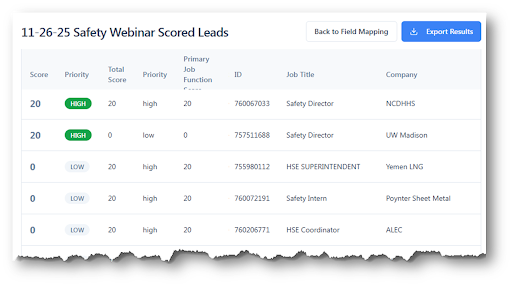
Webinars are often treated as high-volume lead generators, but without AI-driven qualification they still suffer from many of the same limitations as static content downloads. Simply knowing that someone registered or attended provides only a weak signal of intent. Pairing AI-based lead qualification tools with webinars changes this by converting rich engagement data into structured, comparable, and sales-ready insight.
During-webinar AI-driven qualification
Polls redesigned for qualification, not just peer information
AI enables a shift from “engagement polls” which are meant mainly to inform audience participants about the group as a whole, to add buyer need and/or intent. Well-designed polls can reveal:
- Current maturity level
- Scope of the problem
- Organizational readiness
- Peer benchmarks
- Constraints (budget, staffing, timeline)
AI can analyze responses and compare them to other groups and responders such as those using AI-enabled tools. If information is provided in real time during the webinar, this would allow webinar managers to direct questions to the group (or possibly individual attendees) via the internal chat function. This could allow updating of individual readiness scores dynamically and even provide sales people in attendance with direct communication with prospects during the webinar.
Critically, polls must be planned in advance with qualification in mind. Submission of the pools to AI could help ensure that polls are structured to differentiate readiness levels, worded to avoid socially desirable, but inaccurate or untruthful answers and potentially mapped to scoring logic used later by marketing and sales. Examples of these “buyer readiness-included” polls could be:
- Instead of just asking how familiar attendees are with a requirement or regulation, ask where they are in the compliance process
- Ask questions that benchmark a particular performance attribute such as quality problems, profitability or sales volume
- Query the group on metrics they personally will be evaluated on and how they would rate their department’s performance
(As noted, using the above answers “live” presumes the webinar platform is able to transmit such data real time. At the least, the platform must capture individual answers for after event scoring/follow up use.)
Live Q&A and chat analysis
Questions asked during a webinar are often the strongest buying signals, but they are rarely analyzed systematically. AI can process:
- Q&A submissions
- Chat messages
- Follow-up clarifications
- Repeated themes from multiple attendees
This analysis can potentially identify buyers vs observers, technical evaluators vs decision-makers, compliance-driven urgency vs curiosity or prospects asking implementation-specific questions.
Small-group participation and breakout behavior
When webinars include:
- Breakout rooms
- Live exercises
- Small-group discussions
- Interactive scenarios
AI can analyze areas such as participation depth, contribution frequency, language used and problem framing (i.e. severity, timeframe, probability, etc.) If participation in these formats for different segments and applications indicates serious intent ( because it requires effort and in a sense vulnerability), AI can treat this as a high-weight signal rather than just “engagement.”
Post-webinar AI-driven qualification
Live attendance and engagement pattern analysis
Rather than treating attendance as binary (attended vs did not), AI can evaluate:
- When attendees joined and left
- Whether they stay through critical sections
- Re-entry behavior after dropping
- Attention during specific segments
For example, staying through pricing or implementation sections could signal buyer readiness. But leaving after high-level sections may indicate a more early-stage interest. Linking attendance profiles to subsequent actions can increase early-stage buyer identification amid more vague behavior. For example, rejoining after leaving may indicate competing priorities rather than disinterest. Feeding subsequent actions into the model could help identify which path is more likely. Essentially AI could convert these patterns into behavioral engagement scores, far more nuanced than raw attendance duration.
Automated Synthesis of All Webinar Signals
AI can combine:
- Pre-registration data
- CRM enrichment
- Attendance behavior
- Poll responses
- Questions asked
- Post-event actions
Into a single, unified qualification profile per attendee or account including attributes like readiness scoring, risk or urgency indicators, problem categories (i.e. oriented toward service/product production/delivery, or finances), role inference and suggested next steps.
Post-webinar AI tools as qualification accelerators
Rather than sending everyone the same follow-up email, AI can route attendees into interactive post-webinar tools such as:
- Readiness/self-assessments
- Gap checklists
- Cost estimators
- Vendor comparison tools
These tools can extend the conversation, capture additional first-party data, refine scoring further and allow self-qualification at the user’s pace. This is where AI enhanced interactive tools become critical. They act as down-funnel qualification engines, not just one-time consumed content.
Feedback loops into future webinar planning
AI does not stop after qualification. As noted above, if supplied with post-webinar actions by participants, it can also learn more by analyzing which webinar signals correlate with sales meetings gained, opportunities created, deals closed and deal size and velocity. However, if allowed, AI can also Improve future webinar performance by:
- Refining scoring weights
- Identify which topics attract buyers vs browsers
- Optimizing webinar formats (i.e. adding small group interactions afterward or changing to a total question answer format) for revenue impact
If done correctly, over time, webinars can become self-optimizing lead engines, not one-off events.
Next step
Leadsahead designs integrated webinar + AI qualification models.
Request a proposal to pair AI tools with your webinar programs.