
Live AI Tools = Totally unique and valued content
As generative AI summaries and interpretations replace direct information access, content differentiation through one time published, static assets is becoming increasingly difficult. The result is many organizations are creating more content but getting less traffic. And the traffic that does result is based upon more than traditional keyword searching, but because of its uniqueness and value to those who click through and search past the basic AI summaries. Why? The potential villain in this may not just be AI’s free-for-all direct capture and reporting website information, but the non-adapting nature of the content itself.
Static content is inherently duplicable
Whitepapers, reports, and articles—even when well produced—share common limitations:
- They present fixed narratives
- They can be summarized instantly by AI
- They generate limited behavioral insight
- They age quickly
Once published, their value decays both to the user, but also to the promotional channels themselves as “curated” elements of the same topics and text are rehashed and reported over and over again. Fresh and insightful perspectives are what distinguish the best “human” thought leaders, organizations and influencers. Forums are increasingly valued as information sources, even when anonymous, because the real-world problems they tackle are relevant to many, often more believable and highly personalized.
AI Tool Search and Discovery Attraction
Live AI tools offer new opportunities for discovery:
- They can attract users seeking applied answers rather than explanations
- They produce fresh, session-driven content
- They are less susceptible to duplication penalties
- They move beyond simple keyword categories attracting AI search/indexing
Organizations deploying live AI tools gain:
- Differentiated content assets
- Continuous audience insight
- Justification for content investment
- Stronger alignment between content and revenue goals
As zero-click search results increase, tools that require interaction retain value.
Why AI tools are different than one-time published content
AI tools are not read—they are used. This means that each interaction:
- Is shaped by user input
- Produces a unique output
- Generates behavioral signals
- Evolves over time, both within the tool and through external influences
- Can be based upon a wide-scale of user experiences
- Provides patterns and trends that may yet to be apparent
Personalization and specificity are the hallmarks of the AI-influenced age. The key is in managing these to truly deliver value beyond just publishing AI curated content. This means planning, testing, monitoring and continually improving the interactions to avoid producing the “AI-Slop” about which many users are complaining. A viable pathway to valued content is through AI enhanced tools like checklists, self-assessments, benchmarking/comparisons, cost calculators which build upon AI attractions but provide more structure and means of refinement and validation.
AI enhanced online tools provide originality at scale
Because users supply context, constraints, and priorities, AI tools generate:
- Non-duplicable outputs
- First-party datasets
- Aggregated insight similar to surveys—without the chore of doing surveys
Over time, this creates a growing knowledge base that reflects real buyer concerns rather than editorial assumptions. And even if two organizations deploy similar tools, the outputs are inherently different because the value is co-created (and personalized) with the user. But there is value beyond that provided to the user as this content, while not directly exposed externally, can still be promoted as being unique. Additionally, it can be summarized, anonymized and reported in more fixed formats including reports, surveys, FAQ’s, blogs/newsletters and (of course) AI summaries.
How live AI tools provide totally unique content
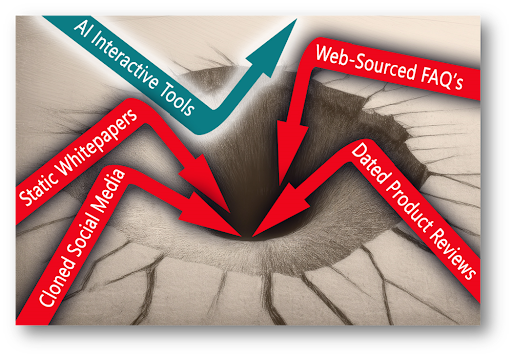
Live AI tools create content that static assets cannot. Each interaction generates original, user-driven output, breaking away from duplicated whitepapers, FAQs, and reviews. This originality enables differentiation, sustained engagement, and discoverability—turning content from a disposable asset into a continuously evolving source of insight and value.
Governing AI through subject expertise
General-purpose AI models are powerful, but they are not domain experts. In technical, regulated, or specialized markets, ungoverned AI can mislead as easily as it can assist. That’s why subject matter expertise (SME) is essential to responsible, effective AI-based tools—and how AI assisted website tools can incorporate it.
General AI models are trained on broad, uneven data which can reflect outdated or conflicting sources, a lack of situational judgment and often cannot assess regulatory nuance or other market or product/service-specific risks. Left ungoverned, they may produce confident but incorrect guidance. Appropriately trained and authoritative SMEs matter in this process because they provide the contextual judgment, domain-specific knowledge and practical experience that goes beyond general internet-sourced documentation.

Authoritative, practical and unique human expertise keeps AI grounded. Subject matter experts guide, correct, and enrich AI outputs, ensuring accuracy, context, and trust. By combining machine intelligence with real-world knowledge, organizations transform generic AI into a differentiated, reliable asset that reflects experience—not just scraped information.
Correcting the “AI regurgitation” problem via direct experience
Embedding SME knowledge into AI tools improves relevance, accuracy, and trust, but also prevents AI “model collapse” meaning that as AI-generated content proliferates, models risk reinforcing their own outputs rather than incorporating new insight. SME-guided training mitigates this by:
- Introducing vetted knowledge
- Correcting drift
- Ensuring novelty and accuracy
So, organizations that invest in SME-guided AI create a more proprietary intelligence that both increases user trust but also key differentiation from other competitors. AI tools can also capture institutional knowledge that might otherwise be lost through turnover, creating continuity over time.
The bottom line: As general AI becomes ubiquitous, expertise-guided AI becomes a strategic asset.
Next step
Leadsahead designs AI tools that function simultaneously as:
- Qualification mechanisms
- Unique content assets
- Insight engines
Request a proposal to deploy live AI tools as part of your content strategy.