
Quick takeaways
- AI scoring matters most when it comes with a clear “why” and a usable summary of the prospect’s intent, not just a rank order.
- A qualified lead reduces sales friction by packaging the prospect’s language, urgency cues, and engagement pattern into a ready-to-use sales brief.
- The best sales outcome comes from operationalizing the deep dive into routing rules, outreach patterns, and repeatable talk tracks.
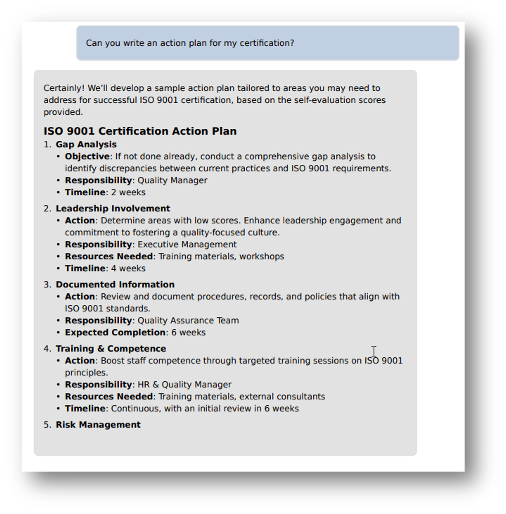
Lead scoring is often treated like a spreadsheet problem: assign points, sort the list, call the top names. That approach misses the real value of AI-qualified leads. The advantage is not the number—it’s the explanation behind the number: what the prospect was trying to accomplish, what signals suggest urgency, what constraints appear, and what path through the tool created those signals. Leadsahead’s “prospect deep dive” concept is built around capturing and structuring those interaction details (with configurable privacy and optional CRM/enrichment integrations), so sales receives context that normally gets lost before the first meeting.
Key Capabilities
- Prospect interactions can be captured, stored, and transmitted for internal use.
- Privacy levels can be tailored and agreed upon based on region- and industry-specific requirements, including compliance frameworks (GDPR, CCPA, etc.).
- Optional CRM integration through APIs reduces manual data handling and ensures timely routing of qualified leads.
- Additional layers of lead scoring and enrichment can be added to strengthen qualification accuracy.
- Consolidated and anonymized prospect output data can be used to enhance the sponsor’s broader dataset for content development, marketing strategy, and more precise prospect direction.
Lead Scoring & Enrichment Inside the Tools
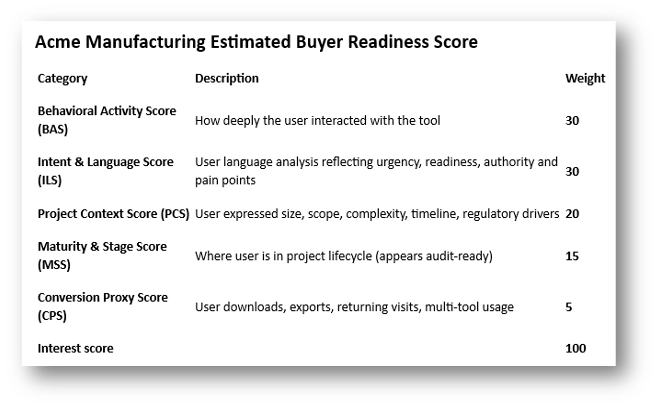
In-tool scoring uses real-time behavioral signals and AI-driven interpretation to evaluate interest, authority, readiness, and fit—before a visitor ever reaches your CRM. This creates a strong foundation for prioritization and tailored follow-up.
Scoring Techniques
- Buyer interest weighting: Uses customizable weighting models to interpret interest across different content areas or tool steps.
- Behavioral scoring: Tracks depth of interaction, including clicks, sections visited, time on page, navigation paths, etc.
- Pain-point density scoring: AI identifies how frequently users mention obstacles, risks, or frustrations and translates this into urgency scores.
- Role validation: AI analyzes free-text descriptions and answers to infer seniority, influence, responsibility scope, and decision authority.
- Micro-conversion scoring: Actions such as entering an email, saving the tool, or exporting a report are scored as meaningful conversion signals.
- Budget-inference modeling: AI estimates likely budget ranges from factors such as industry, project type, and organization size—no CRM data required.
- Continuous model improvement: The AI prompt environment can be tuned to enhance scoring accuracy over time.
- Signal reinforcement from high-intent users: Behavior from users who eventually request help or contact is fed back into the model to strengthen predictive scoring.
- Feedback from CRM data: External CRM outcomes (e.g., closed-won or closed-lost) can be reintegrated to further refine predictive performance.
Lead Scoring & Enrichment Outside the Tools
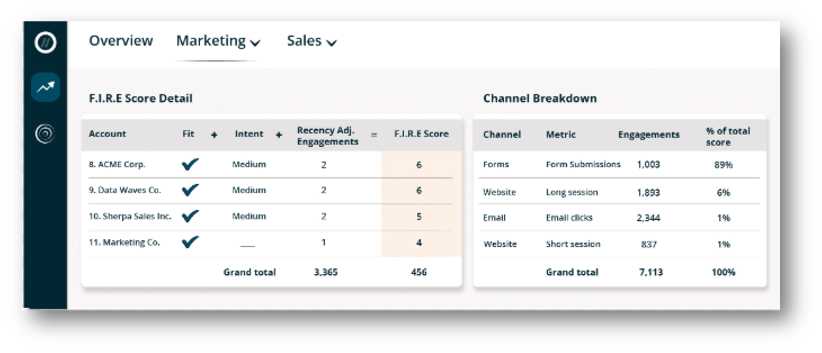
External data enriches lead profiles with firmographic, demographic, historical, and market-level signals. When combined with in-tool scoring, it forms a detailed and actionable picture of both the individual and the buying organization.
External Enrichment Options
- Incorporate company-level intent data from providers such as Bombora or 6sense.
- Connect to sponsor or partner CRMs to pull in historical interaction data and buying status at both contact and company levels.
- Add standard contact/company information such as social activity, contact details, corporate ownership, location, employee count, and estimated revenue.
- Append buyer-intent signals from third-party platforms (e.g., G2) if the same company is researching competitors or adjacent solutions.
- Apply regional or segment-level intent clustering to determine whether a user’s interests reflect broader trends in their market or geography.
Privacy, Compliance & Data Control
AI-driven lead capture requires strong privacy foundations. Configurable privacy settings and transparent consent practices help align the tool with legal requirements and build visitor trust.
Privacy Features
- Adjustable privacy levels: full consent, pseudonymous identifiers, or aggregated-anonymous outputs.
- Region-specific defaults that automatically adapt to local data regulations.
- Clear opt-in/opt-out options for data sharing, marketing use, and CRM sync.
- Data retention controls, consent receipts, and auditable data flow documentation.
What Sales Gets That Traditional Leads Rarely Provide
Many marketing-sourced leads arrive as contact data plus a vague content label. By contrast, AI-enabled tools can capture and structure information while the prospect is actively working through a problem—then pass that structured output forward. This can include the prospect’s problem description, urgency/risk indicators, engagement depth, repeated focus areas, and signals that suggest influence or authority. leadsahead.com+1
That change matters because sales effort is usually wasted in three places:
- Triage (figuring out whether the lead is real)
- Reconstruction (re-asking questions the prospect already answered in their own way)
- Misalignment (starting a conversation with the wrong angle, too early or too late)
A deep dive reduces all three—when it is delivered in a format sales can act on immediately.
The Sales Benefits of Scored and “Explained” Leads
1) Faster, more accurate prioritization
A score without context is easy to distrust. A score with supporting signals (behavior + stated need + inferred readiness) is easier to use for queue ordering, territory routing, and SLA-based follow-up. In Leadsahead’s framing, scoring can happen before a lead ever hits the CRM, using real-time engagement signals plus AI interpretation, and then optionally synced via API.
What changes in practice:
- Fewer “false positives” consuming call time
- Clearer definitions of what qualifies as sales-ready vs. nurture
- Higher confidence in first-touch timing, because the trigger is tied to meaningful in-tool actions (not generic pageviews)
2) More productive first conversations
When a lead packet includes the prospect’s stated problem, what they emphasized repeatedly, and what they appear to be optimizing for, the first call can move quickly into validation and scope.
Common outcomes:
- The opening minutes focus on confirming assumptions, not fishing for basic context
- Discovery questions become targeted (based on what the tool already captured)
- Demos and follow-ups become more specific because the evaluation criteria is clearer
3) Better outreach that sounds less generic
The deep dive supports relevance without requiring “creepy” surveillance language. It can equip reps with credible, non-invasive specificity—anchored to the prospect’s expressed needs and the output they generated for themselves.
What this enables:
- Email/call openings that reference objectives and constraints (not marketing slogans)
- Earlier objection anticipation, because urgency and risk language is visible
- Cleaner handoffs between SDR → AE, because the narrative carries forward
4) Higher-quality qualification and deal shaping
The most valuable use of a score is not “call or don’t call.” It’s deciding how to qualify:
- Does the lead show urgency but low authority? That suggests multithreading and internal champion enablement.
- Does the lead show authority but low urgency? That suggests value framing, business case support, and timing discovery.
- Does the lead show high activity across multiple tool sections? That suggests an active evaluation and a need to map stakeholders and requirements.
Leadsahead’s approach emphasizes that the tool can function like a pre-meeting assistant—engaging users deeper in the funnel, when they are estimating impact and preparing for internal decisions.
5) Cleaner pipeline hygiene and coaching
Even when the deep dive does not guarantee conversion, it improves the quality of the attempt. It provides a standard set of signals that sales leaders can use for:
- consistent qualification notes,
- better call coaching (“what was missed?”),
- and improved forecasting conversations (“what evidence supports this stage?”).
How to Operationalize the Deep Dive for Sales
The difference between “interesting data” and “sales advantage” is process. A useful operational model treats the deep dive as a standard object in the sales workflow.
A practical “lead packet” structure
To make this repeatable, the handoff package can be standardized into a one-page (or CRM panel) format:
- Opportunity hypothesis: what the prospect is likely trying to accomplish (in their language)
- Score + components: overall score plus the drivers (engagement depth, urgency, fit, role signal)
- Key evidence: the top 3–5 signals supporting the hypothesis (e.g., repeated concerns, exports, section depth)
- Sales motion suggestion: best next step (SDR call, AE meeting, partner referral, nurture)
- Risk flags: missing pieces likely to block progress (unknown authority, unclear timeline, mismatch indicators)
Suggested routing rules
A score becomes more actionable when paired with clear routing logic, for example:
- High intent + strong role signal → AE fast-track
- High intent + weak role signal → SDR focuses on stakeholder map
- Moderate intent + strong fit → nurture with scheduled recheck
- Low fit (even with high activity) → redirect to partner/alternative resources
Talk-track starters that reduce friction
Instead of “saw a download,” open with:
- a concise problem restatement,
- a validation question,
- and a “next step” offer tied to the output the prospect already created.
This keeps the first interaction aligned with the prospect’s momentum.
Privacy and Trust Still Matter
AI-qualified lead capture only works long-term when privacy controls are explicit and configurable. Leadsahead positions this as adjustable privacy levels (full consent, pseudonymous identifiers, or aggregated outputs), region-aware defaults, and clear opt-in/opt-out options for CRM sync and data sharing.
Sales benefits here are indirect but real: fewer awkward conversations, higher trust, and less internal risk around data handling.
A Better Standard for “Sales-Ready”
A sales-ready lead is not a contact record. It is a short, evidence-backed narrative that explains intent, urgency, fit, and the most productive next step—delivered in a way sales can use immediately. That is the core promise of the “prospect deep dive” model: transforming tool interactions into structured, actionable sales intelligence, with optional enrichment and CRM integration.
Reach out to see what AI-enhanced lead capture tools might be a good fit for your organization and how you can get started qualifying new leads for free.